|
| Abrasives |
|
| Finest abrasives. | ||
| Microbevels front and back. | ||
| Use a jig. | ||
| Copyright (c) 2002-15, Brent Beach |
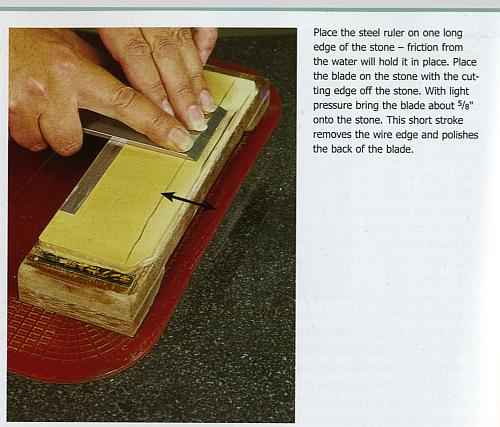 This picture comes from Hand Tool essentials from Popular Woodworking, page 48, in an article by David Charlesworth titled The Ruler Trick. The text does not say, but I have assumed that the stone is 2" by 8" and the ruler width is around 0.32" (8 mm). The line on the right is actually 0.4" (10 mm) from the edge, not the 5/8" mentioned in the text. Since Charlesworth works in metric, I assume this is a conversion error.
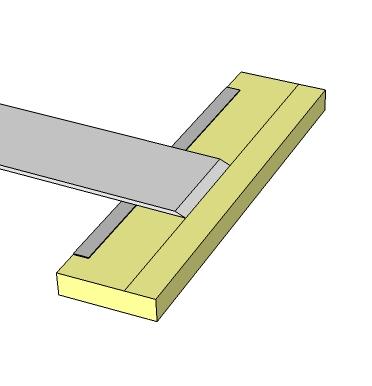 This is a sketchup model of the plane iron, ruler and stone.
The model allows us to get a closeup of the geometry of the honed bevel we get when we use this trick. Using the ruler thickness of 0.5mm (0.02") we find that the honed bevel varies between 1.08 degrees when the blade is 5/8" in from the edge and 0.68 degrees when the blade edge is at the stone edge.
 This is a sketchup image of a worn plane iron. The drawing shows the iron in about the position is has in use.
The wear on the lower face is short and curves steeply to the worn edge. The wear bevel on the upper surface is longer and curves more slowly to the worn edge.
The drawing applies whether the plane iron is bevel up or bevel down. Same drawing but a crucial difference! With a bevel up iron, the short steep wear bevel is on the back face not the bevel face. With a bevel down iron, the short steep wear bevel is on the bevel face (the front face in my usage).
What effect does this variation in honing angle have on honing time? When the blade edge just comes onto the stone, the honed angle is 0.68 degrees. As the blade moves in, the angle increases with honing at the edge at a final angle of 1.08 degrees. As the blade edge moves back toward the stone edge, the blade edge actually lifts off the stone and the blade is sliding on the honed bevel back of the blade edge. Most of the time, honing is occurring back of the blade edge.
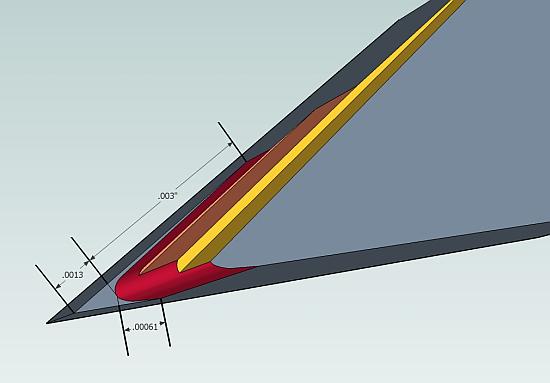 This sketchup model shows two possible results of using the ruler trick. The orange bevel is at 1.08 degrees to the back face and is
Return to the Sharpening and testing home page.
Lost? Try looking around the site map. You can also reach the site map from the little map at the top of each page.
Questions? Comments? You can email me here.